
AI translation has advanced rapidly, with large language models now capable of producing fluent multilingual content at scale. For general use, these systems can be sufficient.
However, when translation becomes operational—integrated into websites, product documentation, regulatory materials, or brand-driven content, another requirement emerges: access to accurate, up-to-date, and context-specific information.
This is where AI translation with RAG (Retrieval-Augmented Generation) becomes essential.
Rather than relying on broadly trained models designed for general language tasks, fine-tuned LLMs are adapted using domain-specific data, approved terminology, and structured linguistic standards. The result is not simply faster translation, but more accurate and consistent output aligned with real business requirements.
What is Retrieval-Augmented Generation (RAG)
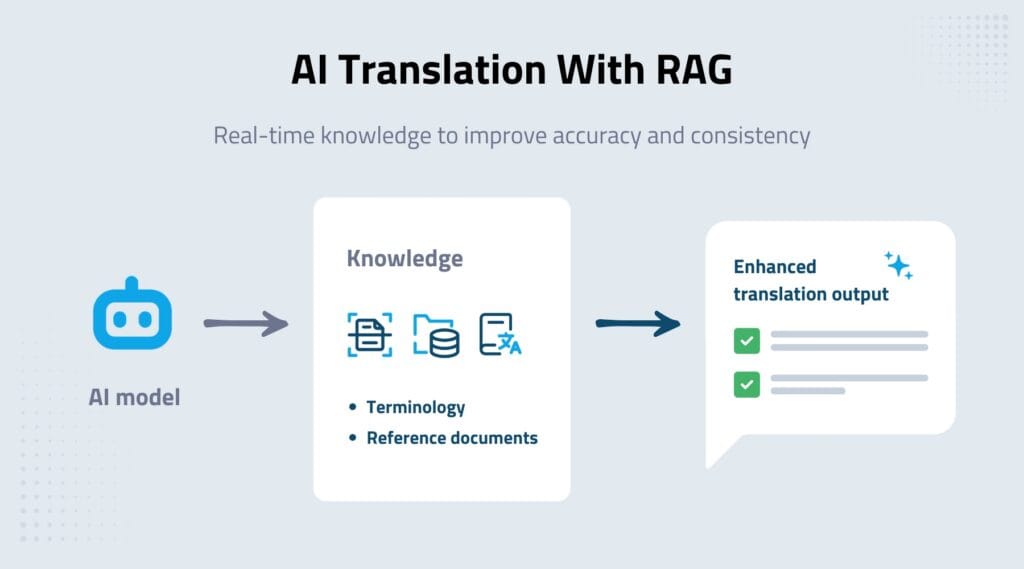
Retrieval-Augmented Generation (RAG) enhances AI models by allowing them to access external knowledge during translation.
Instead of relying only on what the model has learned during training, RAG enables the system to:
- Retrieve relevant content from approved sources
- Reference internal documents, glossaries, or prior translations
- Use that information to guide translation output in real time
This shifts translation from static model behaviour to a knowledge-driven process, where outputs are informed by business-specific context.
Why generic AI translation falls short in real business use
Generic AI models are trained on broad datasets. While they produce fluent output, they lack direct access to:
- Approved terminology
- Industry-specific language
- Internal documentation
- Current product or regulatory updates
As a result, outputs may appear correct but introduce:
- Terminology inconsistencies
- Subtle inaccuracies
- Misalignment with internal standards
As content volume increases, review effort grows, reducing efficiency and limiting the value of AI in production environments.
How RAG improves AI translation accuracy and consistency
AI translation with RAG improves output quality by grounding translation in verified information.
Terminology control
RAG enables the model to reference approved glossaries and translation memory, ensuring consistent terminology across content.
Context-aware translation
By retrieving relevant material, the model better understands how terms are used within a specific business context.
Alignment with internal knowledge
Product documentation, policies, and brand guidelines can be incorporated directly into translation.
Reduced output variability
Outputs follow structured references rather than relying purely on probability, improving consistency.
The result is translation that is more predictable, consistent, and aligned with operational requirements.
How RAG fits into real translation workflows
In production environments, RAG operates within structured workflows.
A typical process includes:
- Content is created or updated in a CMS
- Relevant reference material is retrieved (glossaries, past translations, documentation)
- The AI model generates translation using both learned behaviour and retrieved knowledge
- Outputs are reviewed and approved
This ensures translation is not only fast but also aligned with how organisations manage multilingual content.
Moving towards more reliable AI translation
As organisations move beyond experimentation, translation must deliver consistent, accurate, and context-aware results across all content types.
Relying solely on generic AI models is no longer sufficient. Combining model customisation with retrieval-based knowledge ensures translation aligns with real business requirements, not just general language patterns.
For organisations seeking a structured approach to AI translation with RAG, our Custom AI Translation service provides a framework that combines model fine-tuning with retrieval-based knowledge, using validated terminology, reference content, and defined quality benchmarks rather than relying solely on generic training data.